Make America Psycho Again Donald Trump New York
You Can't Say American Psycho Didn't Warn Us
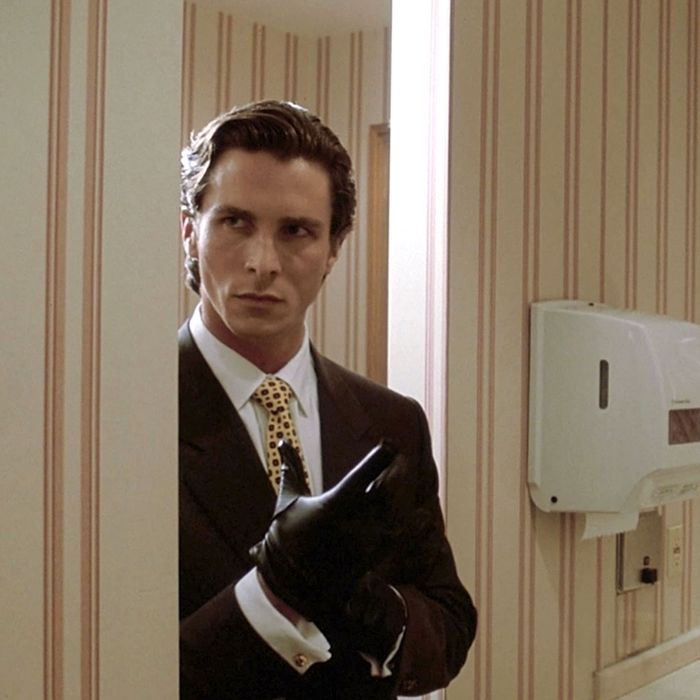
Patrick Bateman told us in the starkest terms that nosotros were living in a world of murderous greed and indifference. Photo: Lions Gate Films
Every week for the foreseeable future, Vulture will be selecting one movie to watch equally part of our new Fri Night Motion picture Club . This week's option comes from our staff writer Lila Shapiro, who volition begin her screening of Mary Harron 'southwardAmerican Psychoon Apr 24 at 7 p.grand. ET. Head to Vulture'southward Twitter to grab her live commentary, and look ahead at adjacent week'southward movie here.
Patrick Bateman, the condition-obsessed Wall Street investment broker who moonlights equally a series killer in American Psycho, has three heroes: fellow mass murderers Ed Gein and Ted Bundy, and Donald Trump. In Bret Easton Ellis'south 1991 novel, Bateman keeps a re-create of The Art of the Deal on his desk-bound and gazes longingly at Trump Belfry — "tall, proudly gleaming." And then he shifts his gaze to the black teenagers standing in front end of it and contemplates murdering them.
In Mary Harron's vicious and glittering accommodation, which came out 20 years ago this month, Trump is referenced just sparingly, but his shadow lies over every scene. When Bateman admires his biceps in the mirror while having sexual practice, when he silently rages with green-eyed over the sight of a colleague's new business concern card, when he tells a date that she will exist ordering the peanut-butter soup with smoked duck (earlier speedily adding that "New York Matinee" chosen it a "playful but mysterious petty dish"), he is conjuring a certain blazon of homo — vain, jealous, absurdly petty, materially wealthy but culturally broke, and higher up all else, obsessed with what other people think. In the New York of the 1980s, that personality reached its apotheosis in the form of the young, glamorous Donald Trump. Aye, glamorous. Before he was an overripe orange spewing conspiracy theories, he was "tall, lean and blond, with dazzling white teeth," a playboy who belonged "to the virtually elegant clubs," every bit the New York Times gushed in 1976.
American Psycho'due south relationship to Trump doesn't end with Bateman'due south emulation of the homo. Over the years, as Trump's stature has risen to previously unimaginable heights, and so has the film's. At the time of its release, it polarized critics, earning a few positive reviews but too wide condemnation. "Even people who liked it wouldn't have considered it an important film," Harron told me in a recent interview. Now it regularly appears on lists of the greatest horror films of the 21st century. Looking back, it can be seen every bit an eerily prescient skewering of the social conditions that allowed Trump to get to where he is now. Throughout the film, Bateman is desperate to confess his crimes, but no ane will listen. When he tells a model at a nightclub that he works in "murders and executions," she tells him, eyes glazed over with boredom, that the guys she knows who piece of work in "mergers and acquisitions actually don't like it." When he tells his lawyer that he's killed 20 — or maybe xl — people, the guy thinks it's a joke. (The existent punch line is that Bateman's lawyer doesn't recognize him, disruptive him for 1 of his look-alike colleagues — a pervasive face-blindness that seems to afflict most of the characters in the story.)
In the end, even the detective investigating one of the murders, played with bright ambivalence past Willem Dafoe, is cheerfully determined not to finger Bateman every bit the suspect. Bateman is psychotic, only so is the culture that surrounds him. Every person he encounters is so insanely self-absorbed, and so consumed by their own quests for condition and wealth, that they aren't just indifferent to his murderous rampage; they reject to acknowledge it. Rewatching the film, you may find yourself thinking of a merits Trump made while he was running for president: "I could stand up in the eye of 5th Avenue and shoot somebody and wouldn't lose any voters, okay?" (Trump was making a point most loyalty, which is where the similarities between Trump and Bateman cease. No one pretends to exist loyal to Bateman; well-nigh people can't remember his name.)
But the fanatical self-absorption that Trump represented in the '80s has only strengthened its grip on American life since then, a fact that's never been clearer than in recent weeks, as Trump and his friends, many of them products of the very institutions that gave rise to Wall Street'south culture of unfettered greed in the 1980s, have used the greatest crisis of our time to funnel staggering sums of money into the coffers of the world's wealthiest companies. Meanwhile, the trunk count is rising. But y'all tin't say that nosotros weren't warned. Bateman told us in the starkest terms that we were living in a world of murderous greed and indifference. Of grade we were incapable of hearing information technology. That was Harron's whole point. "This confession," every bit Bateman concluded at the end of the film, "has meant zilch."
This Fri, beginning at 7 p.one thousand. ET, let's all revisit Harron's film for Vulture's latest Fri Dark Pic order. I'll be livetweeting, only first, I've got to render some videotapes.
American Psychois available to rent on Amazon Prime number, iTunes, Google Play, YouTube, and Vudu, and is available to stream with a subscription to Cinemax.
- Longing for The Way We Were
- Like Ben Affleck, Gigli Deserves a Second Chance
- Catwoman May Be Bad at Being Proficient, Just It'southward Very Proficient at Being Bad
Source: https://www.vulture.com/2020/04/you-cant-say-american-psycho-didnt-warn-us-about-this.html
0 Response to "Make America Psycho Again Donald Trump New York"
Post a Comment