Peer Reviewed Articles on Bullying in Elementary Schools
Bullying
Bullying is intentional behavior that causes another person discomfort or harm. Read the overview below to gain an understanding of the issue and explore the previews of stance articles that examine approaches to address bullying.
Bullying Topic Overview
"Bullying." Gale Opposing Viewpoints Online Drove, Gale, 2019.
In the U.s.a., the definition of bullying has expanded beyond traditional notions of a bigger, stronger child picking on a smaller, weaker victim and typically includes four fundamental elements. The outset part of the definition now includes significant physical, emotional, or psychological harm to the victim. The 2nd is the inability of the victim to stop the bang-up on his or her own. The third is a ability imbalance in which the bully holds more emotional, concrete, or social influence than the victim. The last is repetitive deportment committed by the bully that continue for an extended period. Bullying tin can occur in virtually whatsoever interpersonal setting. While information technology affects young people as well as adults, the issue is primarily considered in contexts involving school-aged children and adolescents.
Advocacy organizations like PACER's National Bullying Prevention Centre notation that definitions of the term vary according to the educational and legal institutions that bargain with the majority of bullying cases. Exceptions to the four elements may occur; for example, if a harmful behavior is severe enough, information technology may exist defined as bullying even if it simply occurs on one occasion.
Antibullying advocates divide bullying beliefs into four master types:
-
Physical bullying: Bullies physically assault their victims or intimidate their victims with the threat of physical violence.
-
Verbal bullying: Bullies mock, shame, and verbally corruption victims with the intent of causing fear or feelings of cocky-deprecation.
-
Social or emotional bullying: Bullies initiate or spread harmful gossip, or intentionally exclude others with the intent of harming or destroying the victim's reputation or social standing.
-
Cyberbullying: Bullies employ electronic media, including social networks, instant messaging, text messaging, Internet forums, smartphone applications, and email (amongst other media) to target victims with text-based equivalents of verbal bullying, or social or emotional forms of bullying.
As reported by the Centers for Disease Control and Prevention (CDC) in 2018, bullying is a common phenomenon in US schools. According to the report, one in five high school students reported being bullied on school grounds in the twelve-calendar month period prior to beingness surveyed. Victimization rates are higher for female students (22 percentage) than male students (16 per centum). A 2018 study from the National Center for Education Statistics found higher victimization rates among centre schoolhouse students (30 percentage of sixth graders and 25 percent of eighth graders) than older students (fifteen percent of eleventh graders and 12 percent of 12th graders). Differences were also noted amidst students in urban and nonurban environments, with 18 percent of students at urban schools, twenty pct of students at suburban schools, and 27 percent of students at rural schools reporting being bullied. Among racial and ethnic groups, 27 percent of American Indian and Alaska Native students, 23 percent of students of 2 or more than races, 23 percent of black students, 23 percentage of white students, 16 percent of Hispanic students, and 7 pct of Asian students reported being bullied.
Bullies, Victims, and Dandy-Victims
A meta-analysis of bullying enquiry performed by researchers at the University of California, Riverside, and the University of Washington has identified several noteworthy characteristics of bullies as well as victims. Researchers found that bullies tend to struggle academically and have issues resolving interpersonal conflicts. They often come from dwelling house environments marked past conflict, violence, depression levels of parental investment, or parental absenteeism and take been found to harbor negative feelings well-nigh themselves and school environments while being prone to negative peer influences. Age appears to influence bullying behavior in specific ways. Younger bullies tend to defy authority figures, be confusing in class, and behave aggressively; older bullies display more qualities associated with feet, depression, and social withdrawal.
Victims of bullying, on the other paw, often take express social circles and underdeveloped social skills. They tend to come from negative home and family environments and accept a history of existence isolated or rejected past peer groups. They are often perceived equally weak or otherwise unable to defend themselves. Victims of bullying besides tend to accept negative outlooks and attitudes and experience difficulties performance in social settings and solving problems posed by immersion in social environments. The term bully-victims refers to individuals who bully others while also being bullied themselves. For case, a smashing-victim may be targeted by older students, so respond by bullying younger students. In add-on to negative self-images and negative attitudes toward peers, bully-victims ofttimes struggle in social situations and are easily influenced in negative ways by the friends and peers with whom they do have regular contact.
Impact and Outcomes
The consequences of bullying can be serious and long-lasting. Young people who are bullied are at increased run a risk for negative psychological and emotional impacts including feet, depression, low self-esteem, alcohol and drug abuse, hostility, delinquency, self-harming beliefs (particularly for girls), and violent or criminal beliefs (specially for boys). Those who are severely bullied are as well statistically more likely to try or commit suicide, and studies accept shown that suicidal ideations are particularly mutual among bully-victims. Bullying can trigger mental health bug in victims who did not previously have any, and it can exacerbate problems in young people with existing mental health bug. Research has also shown that bullying victims tend to suffer declines in bookish performance.
Beyond the risk of injury from a nifty's physical attack, victims may too experience physical symptoms such as sleep disruptions, chronic hurting, and psychosomatic symptoms such as headaches, stomach aches, eye palpitations, and dizziness. Bullying victims also tend to produce higher levels of the stress-related hormone cortisol, which tin interfere with normal brain function. Some researchers conjecture that heightened cortisol levels may explain some of the behavioral bug associated with victimization, such as acting out and showing aggression toward peers, siblings, or parents.
Some pupil population groups are statistically more likely to be targeted by bullies. Immature people in the lesbian, gay, bisexual, transgender, and queer (LGBTQ) customs are at increased run a risk, as are special-needs students, students with disabilities, and overweight or obese students. Racial, ethnic, and religious minorities also tend to attract higher rates of attending from bullies than members of majority groups. For case, black students are bullied at higher rates than both white and Hispanic students. Similarly, Muslim girls who wear hijabs and headscarves, Sikh boys who wear turbans, and Jewish boys who habiliment yarmulkes too written report existence targeted specifically considering of these articles of clothing.
Prevention and Intervention
Experts often refer to a miracle known as the eyewitness effect to help explain why witnesses may not arbitrate to stop a dandy from harassing a victim. A eyewitness is understood to exist someone who is aware that bullying is taking identify, but takes no action to cease it, chooses not to report it, or ignores it altogether.
The eyewitness issue unremarkably occurs equally the effect of one or more of iv factors: the witness believes that the incident is not their business concern or none of their business organization and thus elects non to get involved; the witness believes, correctly or incorrectly, that intervening may describe negative attending from the bully and make the witness more likely to go the nifty'southward next target; the witness does not want to violate unwritten codes of comport among students by telling an dominance figure what is happening; and the witness believes that intervening volition neither stop the bully nor help the victim.
To help counteract the eyewitness effect, many schools take introduced what are normally referred to equally bystander intervention programs. These programs include specific, actionable steps students are encouraged to take if they witness bullying. They are built on fostering a full general school environment that promotes community values and interconnectedness, and they teach students the difference between "telling on someone" and "reporting a blueprint of trouble behavior." Such initiatives likewise piece of work to create empathy betwixt bystanders and victims, and to fix upwardly peer monitoring networks to forestall bullying when adult supervisors are not nowadays. They also aim to empower witnesses and bystanders so that they feel more than able to come forrard.
Protective strategies recommended by StopBullying.gov, a website of the US Section of Health and Homo Services (HHS), include maintaining positive relationships with teachers, edifice good for you friendships, and fugitive unsupervised areas of the school or playground. Recent studies have also given rise to a newer set of strategies such as using humor to defuse tense interpersonal situations and having a potential victim "own" or acknowledge a bang-up's hurtful argument to reduce its perceived bear on. More traditional responses, including pretending to be unaffected and walking away from the situation, go on to exist recommended. Responding with aggression or mocking are non recommended, every bit either may trigger the bully to escalate the situation.
With cyberbullying emerging as a new trouble for young people, advocates and educators also instruct students in online condom best practices. Ane noteworthy strategy revolves around a set of principles known every bit the "forever principle," the "no privacy principle," and the "ex principle." These principles encourage students to presume that anything they post online will exist there forever, that they take no privacy in virtual environments and all information they post tin can exist traced back to them, and that they should never mail annihilation online that they would non trust with an ex-boyfriend or ex-girlfriend.
Schoolhouse administrators also stress the importance of implementing bullying prevention practices, with multitiered systems of support (MTSS) frameworks being considered particularly effective. MTSS models institute universal screening practices to identify potential problems, use early interventions with a collaborative approach to problem-solving, and follow up through post-incident progress monitoring. When necessary, they can be expanded to include the application of external social, mental health, or law enforcement services. MTSS protocols can besides exist applied selectively to ameliorate protect at-risk and vulnerable pupil populations.
Antibullying Laws and Policies
In the United States, there are no federal statutes that specifically accost bullying. However, many types of bullying behavior are covered under existing federal-level harassment and bigotry laws. Schools can be institute legally responsible for pupil conduct if bullying is based on gender, sexual orientation, race, faith, ethnicity, or a concrete or mental disability.
As of 2019, all l U.s. states and the Commune of Columbia have antibullying laws in place. While the specifics of these laws vary from state to country, almost such statutes share some common elements, including purpose statements that declare why the law was passed and how it is to be applied, scope statements that specify the range of social or concrete environments covered by the police force, lists of prohibited bullying behaviors, prevention teaching requirements, requirements for commune policies, and protocols for the reporting and investigation of bullying incidents. Many of these components were recommended by the Department of Educational activity under the administration of President Barack Obama with the specific purpose of preventing bullying in schools. According to a study published in the Cornell Law Review in 2018, but nine states take laws in place that include all sixteen of the department'due south recommendations. Research has likewise constitute that the effectiveness of country laws may vary. An analysis published in JAMA Pediatrics in 2015 found that state statutes with explicit and detailed descriptions of prohibited conduct and clearly stated legal consequences for offenders had stronger associations with reduced bullying rates.
More Articles
Non Every School's Anti-bullying Program Works—Some May Actually Make Bullying Worse
Healy, Karyn. "Non every school's anti-bullying program works—some may really make bullying worse." Gale Opposing Viewpoints Online Collection, Gale, 2020. www.gale.com. Originally published as "Not every schoolhouse's anti-bullying program works—some may really brand bullying worse," The New Republic, nineteen May 2019.
"Schools are under smashing pressure to visibly have activity against bullying."
Karyn Healy is a researcher at the University of Queensland in Brisbane, Commonwealth of australia.
In the following viewpoint, Healy examines a range of academic studies on anti-bullying programs in schools and cautions schoolhouse officials to do similar research before selecting a plan. The author contends that popular approaches like eyewitness intervention can have complicated outcomes, with some studies noting an increase in bullying after implementation. The course level of the students can also touch the outcome of a program, the writer notes, as not all programs that work for younger students will work among high school students. Healy identifies a number of bug in the available information on the effectiveness of anti-bullying programs and urges researchers to conduct randomized controlled trials.
Why Shaming Your Children on Social Media May Brand Things Worse
Kinghorn, Brian Edward. "Why shaming your children on social media may brand things worse." Gale In Context: Opposing Viewpoints, Gale, 2020. www.gale.com. Originally published as "Why shaming your children on social media may make things worse," The Conversation, thirteen Dec. 2018.
"[S]ome parents seem to be seeking validation for their parenting techniques without much thought to how information technology could impact their children."
Brian Edward Kinghorn is an assistant professor of educational foundations at Marshall Academy in Huntington, West Virginia. In the following viewpoint, Kinghorn argues that parents who postal service videos of themselves disciplining their children on social media are engaging in a course of public shaming. The author contends that humiliation is unlikely to be an effective class of discipline and may make a kid's behavioral problems worse. To support his view, Kinghorn provides several studies on the effects of physical punishment, humiliation, and public shaming as forms of discipline. While Kinghorn acknowledges that parents often use social media to learn from and support i some other, he concludes that using social media to publicly shame a kid is parental cyberbullying.
Schools Must Create a Potent Customs Civilisation to Combat Bullying
Van Dirt, Marker. "Schools Must Create a Potent Community Culture to Combat Bullying." Gale Opposing Viewpoints Online Collection, Gale. 2020. www.gale.com. Originally published as "Cultural Glue for Binding an Unstable World," Schoolhouse Administrator, Apr. 2018.
"Cultural mucilage is required to provide a receptive host for whatever long-term, sustainable school comeback efforts."
Mark Van Clay, a sometime school superintendent, is a consultant at the Consortium for Educational Modify and co-author of Aligning Schoolhouse Districts as PLCs and The School Lath Fieldbook: Leading with Vision.
In the following viewpoint, Van Dirt argues that schools need to develop a ready of shared cultural values for anti-bullying initiatives and other schoolhouse-improvement efforts to succeed in producing long-lasting modify. The author identifies a variety of factors that contribute to an apparent lack of shared values in wider Us culture to underscore the importance of fostering a set up of shared values in schools and classrooms. Van Clay encourages school leaders to evaluate and revise their existing cultural norms so that stated values, such as being against exact bullying, are reflected and modeled in the behavior of adults and students alike.
Bullying Isn't But Verbal or Physical – It Can Besides Be Social, and This Can Have the Worst Effects
Chester, Kayleigh. "Bullying isn't just verbal or physical – information technology tin besides be social, and this can have the worst furnishings." Gale Opposing Viewpoints Online Collection, Gale, 2020. www.gale.com. Originally published equally "Bullying isn't just verbal or physical – information technology tin also be social, and this can have the worst effects," The Conversation, iii Jan. 2018.
"We accept come a long way since bullying was viewed as just an unavoidable part of life, a rite of passage during your schoolhouse years."
Kayleigh Chester is a doctoral candidate in child and adolescent psychology at the University of Hertfordshire in England.
In the following viewpoint, Chester argues that schools, parents, and professionals overemphasize verbal and concrete forms of bullying but neglect relational bullying in their anti-bullying efforts. Relational, or social, bullying is beliefs that targets a victim's peer relationships or social status, the author explains, and tin be difficult to identify. Considering relational bullying is understudied and underemphasized, Chester contends, some of the nigh damaging and harmful bullying goes unaddressed by adults. The author asserts that anti-bullying efforts need to educate children and adults about what relational bullying is, how information technology appears in social interactions, and how to intervene effectively.
Fast Facts
United states Students Ages 12–eighteen Who Notified an Adult at School later Being Bullied, by Selected Characteristics, 2017
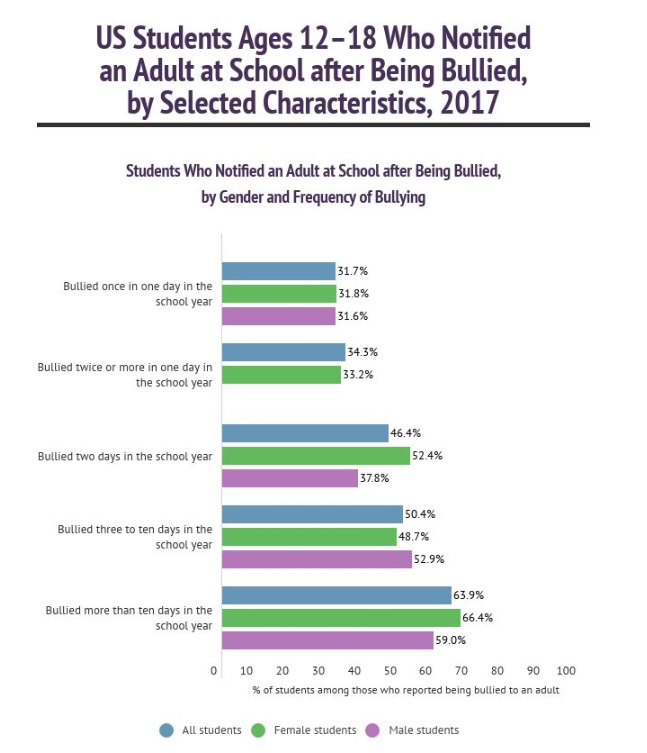
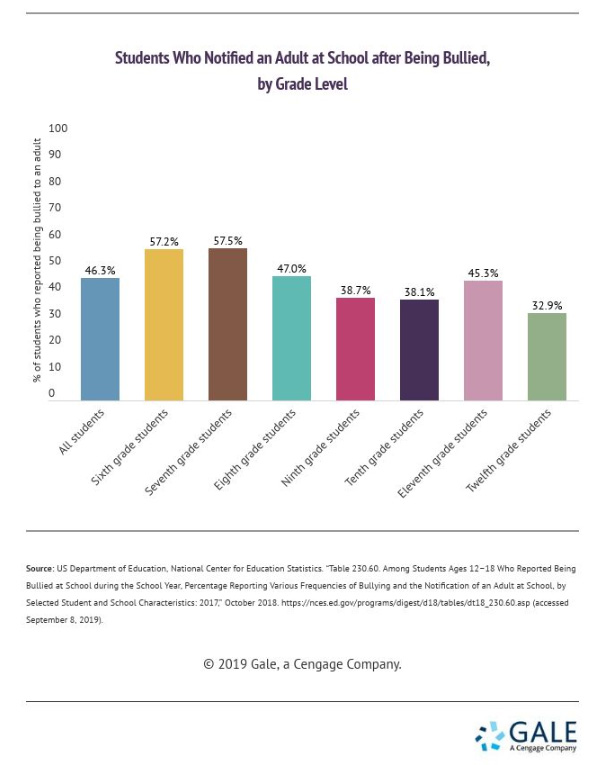
Source: "U.s. Students Ages 12–eighteen Who Notified an Adult at School after Being Bullied, past Selected ..." Gale Opposing Viewpoints Online Collection, Gale, 2019. www.gale.com.
Source: https://www.gale.com/open-access/bullying
0 Response to "Peer Reviewed Articles on Bullying in Elementary Schools"
Post a Comment